
How Music Shapes Emotion: From Sales Pitches to Waiting Rooms


Introduction
Human behavior is driven as much—if not more—by emotion as by logic. Over the past two decades, research in neuroscience and psychology has consistently shown that music has a profound influence on mood, attention, and patience.
The right soundtrack can make people lean in and listen closely to a sales pitch, or relax and wait calmly in a lobby without frustration. In this article, we’ll explore how music shapes emotion, attention, and memory, and how you can use it to create better brand experiences—backed by science, not guesswork.
1. Music and the Brain: The Science Behind Emotional Engagement
Music activates multiple brain regions tied to reward, emotion, and motivation. In a landmark PET imaging study, Blood and Zatorre (2001) found that music capable of producing “chills” increased activity in the amygdala, ventral striatum, orbitofrontal cortex, and prefrontal cortex—areas associated with pleasure, arousal, and decision-making.
This activation also triggers the release of dopamine, serotonin, and oxytocin—neurochemicals linked to reward, bonding, and emotional engagement (Blood & Zatorre, 2001; National Institutes of Health, n.d.).
In practice, this means that music can prime listeners to be engaged and open before any words are spoken—a valuable advantage in sales, service, or hospitality.
2. Waiting with Calm: How Music Helps Us Be Patient
Waiting rooms and lobbies are often unavoidable, but how people feel while waiting can make or break their perception of your brand.
A field experiment by Caldwell and Hibbert (1999) demonstrated that slow-tempo music significantly increases dwell time and reduces perceived waiting time. Patrons exposed to slow music spent an average of 80.3 minutes in a restaurant—about 40% longer than those hearing fast-tempo music (57.3 minutes). Importantly, slow music also led guests to underestimate the actual time spent.
In waiting contexts, slow, ambient tracks can reduce tension, make time feel shorter, and keep people from becoming restless. This not only improves their experience but also protects your brand from the negative impact of frustration—especially in an era where unhappy customers can instantly broadcast their feelings on social media.
3. Engaging Attention: Music Makes Pitches More Persuasive
Music isn’t just background—it’s an emotional primer that can make your message more compelling.
Emotional Priming – The emotional tone of music can shape how listeners interpret what they hear afterward. A confident, uplifting track can make a sales pitch feel more inspiring; a calm, steady soundtrack can make a service explanation feel more trustworthy.
Music isn’t just background—it’s an emotional primer that can make your message more compelling.
-
Emotional Priming – The emotional tone of music can shape how listeners interpret what they hear afterward. A confident, uplifting track can make a sales pitch feel more inspiring; a calm, steady soundtrack can make a service explanation feel more trustworthy.
-
Attention Anchoring – Moderate background music can reduce distractions, guiding listeners to focus on the speaker (Madsen & Fredrickson, 1993).
-
Arousal Matching – Droit-Volet et al. (2013) showed that tempo directly influences arousal levels: fast tempos increase energy and excitement; slow tempos encourage calm and reflection. Matching the tempo to your pitch goal helps align emotional state with message intent.
For example, an upbeat pop-electronic track can enhance enthusiasm during a product launch presentation, while a softer, ambient score can encourage deep trust during a one-on-one client consultation.
In short, music can subtly guide emotional responses so the audience is already leaning toward “yes” before you even make the ask.
Attention Anchoring – Moderate background music can reduce distractions, guiding listeners to focus on the speaker (Madsen & Fredrickson, 1993).
Arousal Matching – Droit-Volet et al. (2013) showed that tempo directly influences arousal levels: fast tempos increase energy and excitement; slow tempos encourage calm and reflection. Matching the tempo to your pitch goal helps align emotional state with message intent.
For example, an upbeat pop-electronic track can enhance enthusiasm during a product launch presentation, while a softer, ambient score can encourage deep trust during a one-on-one client consultation.
In short, music can subtly guide emotional responses so the audience is already leaning toward “yes” before you even make the ask.
4. Memory and Recall: Music Boosts Message Retention
One of music’s most powerful marketing effects is its ability to enhance recall.
Huron (1989) noted that music adds structure and continuity to messages, making them easier to remember. Nostalgic or familiar melodies also tap into emotional memory pathways, activating brain areas that strengthen long-term recall (Janata et al., 2007).
Applied to a sales pitch, this means that a well-chosen soundtrack not only shapes the listener’s mood at the moment, but also increases the odds they will remember—and act on—your message later.
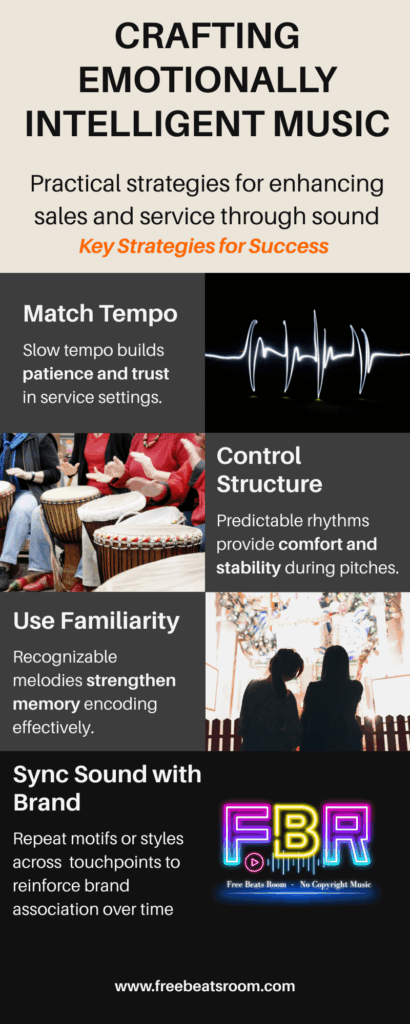
5. Practical Strategies: Crafting Emotionally Intelligent Music for Sales & Service
6. Real-World Example
Imagine a healthcare clinic that plays slow, instrumental ambient music in its waiting room. Patients feel calmer, report that the wait feels shorter, and arrive at their appointment in a more positive frame of mind.

At the same time, the clinic’s promotional video uses a medium-tempo, uplifting track to introduce a new wellness program, making the message more engaging and memorable. In both cases, the music works as an emotional and cognitive bridge between the customer’s state of mind and the brand’s goals.
Conclusion
Music is far more than a decorative touch—it’s a scientifically validated way to influence emotion, attention, and memory. Whether helping someone feel patient in a lobby or receptive during a sales pitch, music can prime the mind for positive engagement.
At Free Beats Room, we create royalty-free tracks designed with these psychological principles in mind—so you can use them to elevate your customer experience without licensing restrictions.
References
- Blood, A. J., & Zatorre, R. J. (2001). Intensely pleasurable responses to music correlate with activity in brain regions implicated in reward and emotion. Proceedings of the National Academy of Sciences, 98(20), 11818–11823. https://doi.org/10.1073/pnas.191355898
- Caldwell, C., & Hibbert, S. A. (1999). Music and time perception: The influence of tempo. Journal of Restaurant & Foodservice Marketing, 2(1), 55–69. https://doi.org/10.1300/J061v02n01_05
- Droit-Volet, S., Ramos, D., Bueno, J. L. O., & Bigand, E. (2013). Music, emotion, and time perception: The influence of subjective emotional valence and arousal. Frontiers in Psychology, 4, 417. https://doi.org/10.3389/fpsyg.2013.00417
- Gobe, M. (2001). Emotional branding: The new paradigm for connecting brands to people. Allworth Press.
- Huron, D. (1989). Music in advertising: An analytic paradigm. The Musical Quarterly, 73(4), 557–574. https://doi.org/10.1093/mq/73.4.557
- Janata, P., Tomic, S. T., & Rakowski, S. K. (2007). Characterization of music-evoked autobiographical memories. Memory, 15(8), 845–860. https://doi.org/10.1080/09658210701734593
- Madsen, C. K., & Fredrickson, W. E. (1993). The experience of musical tension: A review of the literature. Journal of Research in Music Education, 41(4), 294–305. https://doi.org/10.2307/3345503
- National Institutes of Health. (n.d.). The neuroscience of music. https://www.nih.gov/

🎵 Soundtracks that move minds.
🧠 Created by experts in psychology, marketing & music.
Contact Us
📬 Contact us for collaborations, special requests, or business opportunities — we’d love to hear from you! [email protected]